Manual SEO Versus Automated Content Creation for Growing a Small Business Site
Discover the differences between manual SEO and automated content creation. Compare costs, speed, and traffic results to grow your small business site in 2026.
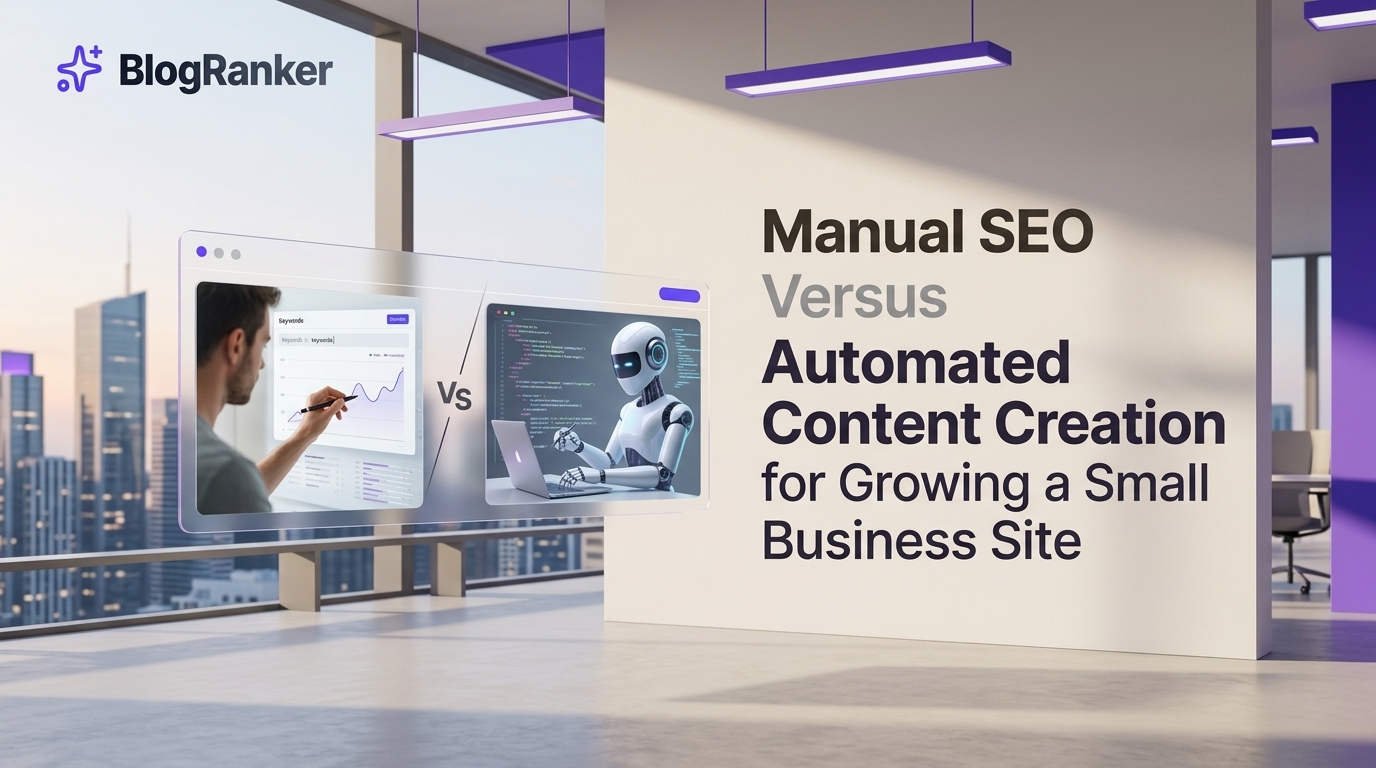
Growing a small business website used to mean spending months researching keywords and weeks writing a handful of articles. In 2026, the gap between businesses that scale and those that stagnate is defined by how they produce content. Most founders find themselves trapped in a cycle of manual labor that produces slow results while competitors use modern systems to dominate search results.
Traditional methods often fail to keep up with the speed of current search engines. If you want to build a site that attracts thousands of visitors, you must decide between the hands-on approach and the efficiency of automation. This article breaks down the costs, results, and long-term viability of both methods so you can choose the best path for your business growth. To get the most out of your visual content while choosing a strategy, you can learn How To Use An AI Prompt Optimizer To Get Better Midjourney Image Results to improve your site's aesthetic appeal.
Table of Contents
- The Search Reality in 2026
- Understanding the Manual SEO Workflow
- The Impact of Automated Content Creation
- Comparison of Manual Versus Automated SEO
- Cost Analysis for Growing Businesses
- Keyword Research Speed and Precision
- Building Topical Authority in Record Time
- Preparing for Generative AI Optimization
- Frequently Asked Questions
The Search Reality in 2026
Search engines no longer just look for keywords; they look for comprehensive coverage of a topic. In 2026, Google and other search platforms prioritize entities and topical authority over simple backlink profiles. This means a site with 500 high-quality articles about a specific niche will almost always outrank a site with 50 perfect manual articles. The volume of high-intent content required to stay visible is higher than ever before.
For many small business owners, the sheer volume of content needed feels impossible. You are competing against sites that update daily. Using tools like How to Use Google Gemini Prompts to Automate Small Business Marketing Tasks helps bridge the gap, but the core strategy must be sound. Small businesses need to be visible not just in standard search, but in AI-generated overviews and assistant responses.
Understanding the Manual SEO Workflow
Manual SEO is a labor-intensive process that involves several stages of human intervention. It starts with manual keyword research using tools that require hours of filtering. Then, a content brief is created, followed by a writer drafting the piece. After the draft is finished, an editor reviews it for SEO alignment and brand voice. Finally, a manager uploads it to the website and manually builds internal links.
This process ensures a high level of nuance but comes with a high price tag and slow turnaround times. When you look at Manual SEO Content vs Automated SEO Software for Scaling Your Rankings, it becomes clear that the manual path is often a bottleneck for startups. A single person can realistically produce only three to five high-quality articles per week while managing other business tasks. This pace makes it difficult to achieve the density of content required to dominate a niche.
The Impact of Automated Content Creation
Automated content creation has evolved significantly. By 2026, AI engines do more than just generate text; they perform deep research, analyze competitor gaps, and structure articles for maximum readability. These systems can produce hundreds of articles in the time it takes a human to write one. This speed allows small businesses to test thousands of keywords and find which ones actually drive revenue.
Automation does not mean low quality. Modern platforms use sophisticated prompt engineering to ensure that every article provides value to the reader. By utilizing the 9 Best AI Keyword Research Tools To Find Low Competition Search Queries, businesses can find untapped opportunities that manual research might overlook. This allows for a massive influx of indexed pages that catch long-tail traffic, which often converts better than broad, competitive terms.
Comparison of Manual Versus Automated SEO
To see how these two methods stack up, we must look at the key performance indicators that matter to a small business. The following table compares the two approaches across vital metrics.
| Feature | Manual SEO | Automated Content Creation |
|---|---|---|
| Production Speed | 3-5 articles per week | 100+ articles per day |
| Cost per Article | $50 - $200+ | Less than $1 |
| Keyword Coverage | Limited to high-volume terms | Deep long-tail coverage |
| Operational Overhead | High (managing writers) | Low (platform management) |
| Time to Results | 6 - 12 months | 2 - 4 months |
| Topical Authority | Slow to build | Rapidly established |
Success in the current digital environment depends on how quickly you can respond to new trends. If you are waiting for a writer to return a draft, you are losing leads to competitors who have already published their content. You can learn more about how How to Use Google Gemini Prompts to Automate Small Business Marketing Tasks can streamline these internal processes even further.
Cost Analysis for Growing Businesses
Small businesses must be careful with their budgets. Hiring a dedicated SEO agency or a full-time content writer can cost thousands of dollars every month. For many SaaS founders and entrepreneurs, this expense is hard to justify when the return on investment takes months to appear. Manual SEO is essentially a linear cost; to get more content, you have to spend more money.
In contrast, automated content creation offers an exponential return. Once you have a system in place, the cost of producing an additional 100 articles is negligible. This allows you to spend your budget on other growth areas like product development or paid acquisition. If you want to know How to Get Your Business Recommended by ChatGPT for High Intent Sales Leads, you need a large footprint of content that AI models can crawl and index. Automation provides that footprint at a fraction of the cost.
Keyword Research Speed and Precision
Manual keyword research is prone to human bias. Writers often target keywords they think are important, rather than what the data suggests. They might ignore low-volume keywords that are highly relevant to their target audience. Manual researchers also struggle to keep up with the thousands of variations that users type into search bars every day.
AI-driven engines analyze billions of data points to find clusters of related keywords. This ensures that your site covers every aspect of a topic, which signals to Google that you are an authority. To get the best results from your AI tools, you should use How To Use An AI Prompt Optimizer To Get Better Midjourney Image Results to understand how better inputs lead to better outputs across all generative tasks. High precision in keyword selection means less wasted effort and more targeted traffic.
Building Topical Authority in Record Time
Topical authority is the holy grail of SEO in 2026. It is the measure of how much a search engine trusts your site as a source of information on a specific subject. To build this trust, you need to provide answers to every possible question a user might have. If you only write ten articles about a topic, you aren't an authority. If you write three hundred, you are.
Automated systems allow you to map out an entire topic and generate the necessary content in days rather than years. This rapid deployment forces search engines to take notice. When combined with smart internal linking, this strategy creates a web of information that keeps users on your site longer. High-quality automation ensures that each piece of content is interconnected, which helps boost the rankings of your entire domain, not just individual pages.
AI Strategy Prompt
To help you get started with a high-level content strategy, use the following prompt with your preferred AI engine:
Preparing for Generative AI Optimization
Generative AI Optimization (GAIO) is the new SEO. It involves optimizing your content so that AI models like ChatGPT, Gemini, and Claude recommend your business in their responses. These models look for clear, factual, and authoritative content. They prefer sites that have a large volume of consistent information about a niche.
Manual content creation is often too slow to feed the hunger of these LLMs. By the time a manual article is written and indexed, the AI models may have already formed their primary recommendations based on other available data. Using automation allows you to be the first to cover new developments in your industry, ensuring that you are the source that AI models cite. This leads to high-quality leads that come directly from AI conversations, often bypassing traditional search result pages entirely.
Conclusion
The choice between manual SEO and automated content creation is no longer about quality versus quantity; it is about scale and survival. Manual SEO is still valuable for cornerstone content and high-level brand storytelling. However, for a small business looking to grow traffic quickly and build domain authority, automation is the only viable path in 2026.
By automating the bulk of your content production, you can cover more ground, target more keywords, and establish yourself as an authority before your competitors even finish their first content brief. Use the saved time to focus on closing sales and improving your product. If you want to dominate your niche, start integrating automated engines into your growth strategy today.
Frequently Asked Questions
Does Google penalize AI-generated content?
No, Google prioritizes the quality and helpfulness of content regardless of whether it was created by a human or an AI. As long as the content satisfies user intent and provides value, it will rank.
Can small businesses compete with large corporations using AI?
Yes, automation levels the playing field by allowing small teams to produce the same volume of content as large departments, often with more agility and niche focus.
How many articles should I publish to see results?
While it varies by industry, most small business sites see a significant lift in traffic and authority after reaching a threshold of 100 to 200 well-optimized articles on a specific topic.
Is manual SEO still necessary?
Manual SEO is best reserved for highly strategic pages like your homepage, key service pages, and deep-dive thought leadership pieces that require a personal brand voice.
Created by BlogRanker.
KEEP READING
Discover more insights and strategies


Scale your traffic today.
Stop wasting hours writing manually. Let BlogRanker generate and publish high-ranking content for you on autopilot.
Try BlogRanker Free